
Aligning Certification with Business Goals
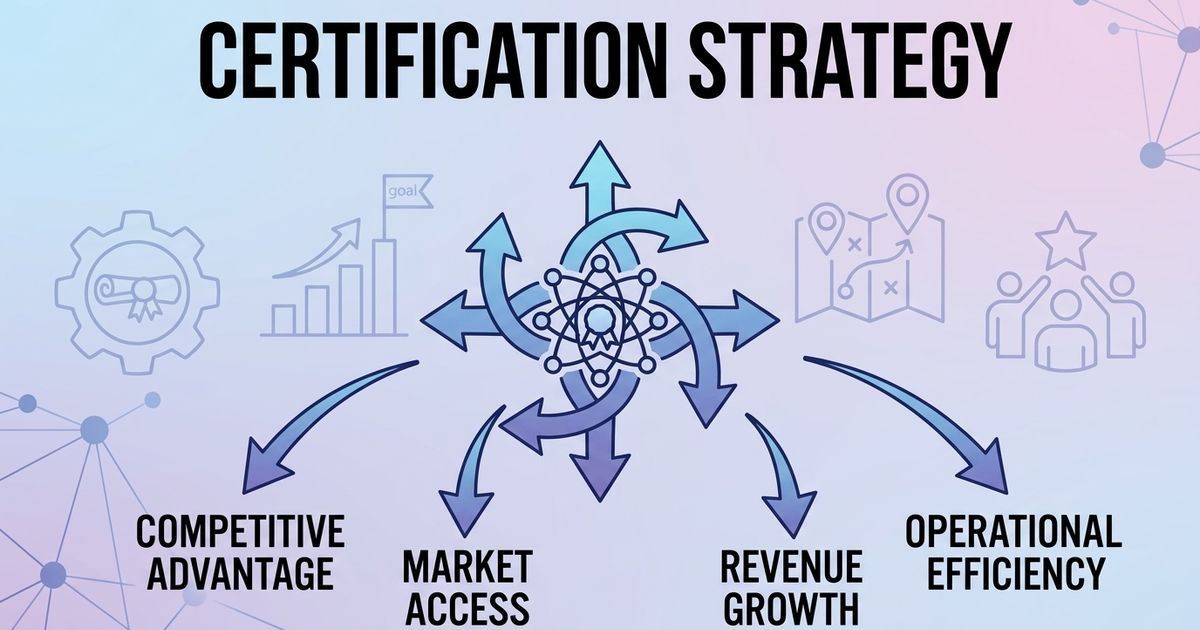

Building a Certification Strategy That Aligns with Business Goals, Not Just Résumés
"Training without alignment is cost without purpose." It's a blunt way to put it, but it captures exactly what goes wrong when certification programs get approved because they sound reasonable rather than because they connect to a specific business outcome leadership can point to afterward.
Want a certification strategy tied directly to your business priorities?
Most certification programs get built from the bottom up: an employee requests a credential, a manager approves it, and the decision never touches a broader strategic conversation. This isn't necessarily wrong for any single request, but at scale, it produces a certification portfolio that's essentially a collection of individual preferences rather than a coordinated response to where the organization actually has skill gaps that matter to its goals.
Stats That Matter
- 87% of companies say they are experiencing or expect to experience workforce skills gaps, yet only 49% report that aligning learning with business goals is even a stated top priority.
- Organizations are shifting decisively from role-based training toward skills-based frameworks, treating skills — not job titles — as the unit that training investment should target.
- 76% of employees say they're more likely to stay with a company that offers continuous learning opportunities, tying certification strategy directly to a measurable retention outcome, not just a skills outcome.
Why Individual Requests Don't Add Up to a Strategy
The gap between "87% expect skills gaps" and "only 49% prioritize aligning training with goals" is the central problem this article addresses. Organizations broadly recognize they have a skills problem, but fewer than half have made the connection between what they train for and what the business is actually trying to achieve. This mismatch produces a familiar and expensive pattern: a training budget that gets fully spent every year without leadership being able to point to which business outcomes it actually moved.
The fix isn't rejecting individual certification requests — it's adding a layer above them. A certification strategy, done properly, starts with the business objective — expanding into a new market, reducing delivery risk, building capability in a specific technical area — and works backward to identify which specific skill gaps block that objective, rather than starting with which certifications are popular or which employees have asked for support.
The Shift from Role-Based to Skills-Based Thinking
A structural shift underway across corporate learning strategy is directly relevant here: organizations are moving away from mapping training to job titles and toward mapping it to specific skills, tracked at a much more granular level than "this person is an engineer, so they get engineer training." This shift matters for certification strategy specifically because it changes the starting question from "what certifications exist for this role" to "what specific skill gap, sitting inside this role or across several roles, is actually blocking a business priority."
This reframing also solves a common certification-strategy failure mode: certifying people broadly within a role category, some of whom already have the underlying skill and some of whom need something different entirely, because the certification was mapped to a job title rather than an actual, verified gap.
What a Business-Aligned Certification Strategy Actually Looks Like
Start from the business objective, not the training catalog. Before approving a category of certification spend, identify the specific initiative it's meant to support — a market expansion, a compliance requirement, a technical capability the organization currently lacks. If a proposed certification program can't be tied to a specific initiative in a sentence, it's not yet a strategy — it's a menu of options.
Run a skills gap analysis before allocating budget, not after. Understanding where the organization actually stands relative to where it needs to be ensures certification spend targets the highest-impact gaps first, rather than being distributed evenly across teams regardless of where the real shortfall is.
Build cross-functional ownership, not just an HR or L&D initiative. The organizations getting the strongest alignment have learning teams working directly with business unit leaders — not designing programs in isolation and then presenting them to the business for approval. When business leaders help define the skill gap in the first place, the resulting certification investment is far more likely to map to something they'll actually recognize the value of later.
Track outcomes tied to the business objective, not completion rates. A completed certification is not the same as a closed skill gap. The strategy should specify, in advance, what changes in the business if the gap is closed — faster delivery on a specific initiative, reduced risk in a specific process — and measure against that, not against how many people passed an exam.
Why This Also Solves the Retention Problem
A well-aligned certification strategy carries a retention benefit that a scattershot one doesn't capture as effectively. Employees are measurably more likely to stay with an employer that offers continuous learning tied to real career and business relevance — but the operative word is relevance. A certification that clearly connects to a business priority the employee can see and understand carries more weight for engagement and retention than a generic credential offered because it was available, precisely because the employee can see the organization is investing in a skill it actually needs, not just checking a development box.
The Cost of Skipping This Step
Without an explicit strategy layer above individual certification requests, organizations tend to end up with a training budget that's fully spent but hard to defend in a leadership review — lots of activity, unclear connection to outcomes. This is precisely the scenario that makes certification budgets vulnerable to cuts in tighter years, because there's no clear business case connecting the spend to results leadership can point to. A strategy-first approach protects the budget by making the connection explicit from the start, rather than trying to construct it retroactively when the budget gets questioned.
Key Takeaways
- 87% of companies expect skills gaps, but fewer than half treat aligning training with business goals as a stated priority — that gap is where certification budgets lose their defensibility.
- Effective certification strategy starts from the business objective and works backward to the specific skill gap, rather than starting from a menu of available certifications.
- The broader shift toward skills-based (rather than role-based) training frameworks helps target certification spend at actual gaps rather than distributing it evenly across a job title.
- Cross-functional ownership between learning teams and business unit leaders produces certification investment that's more clearly tied to outcomes leadership recognizes.
- A well-aligned certification strategy also strengthens retention, since employees respond more strongly to training they can see is tied to real business relevance, not a generic development checkbox.
What to Do Next
If your certification budget is fully spent every year without a clear line back to business outcomes, that's a strategy gap, not a training gap — and it's fixable before your next budget cycle.
I work with a trainer who specializes in exactly this: helping leadership build certification strategies that start from business priorities and work backward to the specific skills that close them. If this is on your radar for the next quarter, call or contact me and I'll help you get started.